
Amidst the global surge in organic agriculture, the diversity of organic raw materials presents abundant possibilities for fertiliser production. Selecting the appropriate production line is pivotal to transforming raw material value into high-quality fertilisers. Given the significant variations in physical properties and composition among different organic inputs, only through purpose-built production lines can both resource efficiency and product quality be assured.
Livestock manure-based materials are rich in fundamental nutrients such as nitrogen, phosphorus, and potassium, yet their high moisture content and tendency to generate odours necessitate high-temperature aerobic fermentation systems. These production lines utilise intelligent temperature control equipment to maintain fermentation temperatures between 55-65°C. This not only rapidly eliminates pathogens and weed seeds but also facilitates microbial decomposition of coarse fibres, transforming manure into loose, aerated organic fertiliser. When integrated with dewatering equipment and crushing/screening units, these systems process diverse materials including chicken manure and cattle dung. The finished product achieves moisture content below 30%, meeting international transport and storage standards.
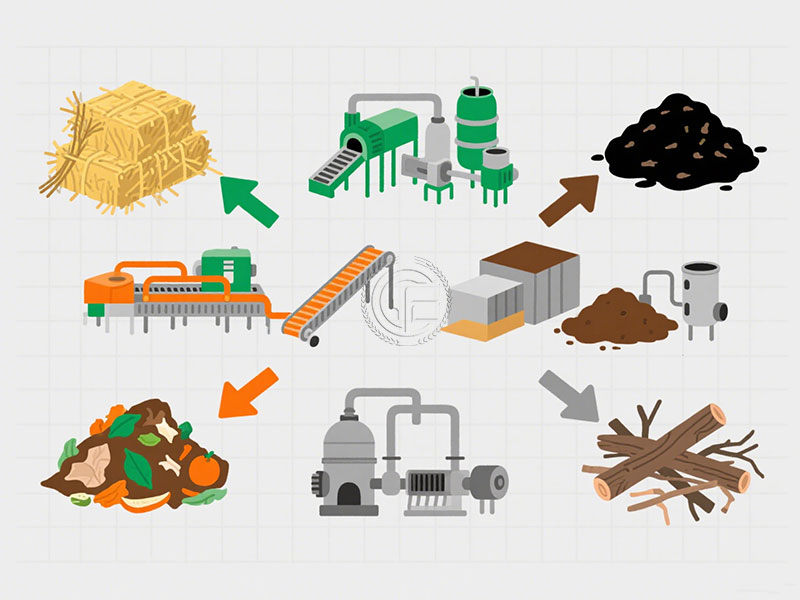
Agricultural and forestry residues like straw and sawdust possess high cellulose content and imbalanced carbon-to-nitrogen ratios, necessitating pre-treatment via integrated mixing-fermentation production lines. Raw materials are first shredded to 3-5cm lengths using a shredder, then proportionately supplemented with nitrogen source regulators to balance carbon-nitrogen ratios before entering continuous fermentation chambers for gradient decomposition. This process effectively breaks down lignin structures, reducing the maturation cycle to under 20 days. The resulting organic fertiliser achieves over 60% organic matter content, making it particularly suitable for markets with stringent organic certification requirements, such as Europe and North America.
For high-fat, high-salt organic waste like kitchen waste, a dedicated sorting-desalting-fermentation production line is required. Front-end intelligent sorting equipment removes impurities like plastics and metals. A washing and desalination system reduces salt content to below 3%, after which the material enters enclosed fermentation tanks for harmless treatment. The production line employs a PLC fully automated control system, continuously monitoring parameters such as pH and oxygen concentration to ensure the finished product complies with international standards like EU EC 889/2008, providing a compliant solution for waste resource utilisation. From raw material analysis to production line customisation, we consistently prioritise **‘precision matching’** as our core principle, delivering comprehensive one-stop services encompassing process design, equipment selection, and installation commissioning for global clients. Whether for compact 5-tonne/day systems or large-scale 100-tonne/day projects, we optimise workflows according to feedstock characteristics, empowering customers to seize market opportunities in the organic fertiliser sector.
Like this article? Get in touch with us for industry updates and expert advice on fertilizer processing and handling.